

Coral Reefs of Palau: Nature’s Amazing Underwater Cities
Provided by: The Nature Conservancy|Published on: June 14, 2025
Grades: 3, 4, 5, 6, 7, 8
Type: Lesson Plans
Subjects: Biology
Authors: Nature Lab by The Nature Conservancy
Region: Oceania
Languages: English
This resource has been reviewed by SubjectToClimate's climate scientists and verified for scientific accuracy and up-to-date information. Learn about our review process →
This resource has been reviewed by SubjectToClimate's climate scientists and verified for scientific accuracy and up-to-date information. Learn about our review process →
Synopsis
- In this virtual field trip from Nature Lab by The Nature Conservancy, students will "visit" Palau and hear from a marine biologist who has studied the coral there.
- Students will learn the importance of coral to the ecosystem and people, the biology of coral, and how climate change and ocean acidification are impacting them.
- Students will view a 42-minute video and answer discussion questions to demonstrate their understanding of the video.
Teaching Materials
Positives
- The interview with the scientist gives students a glance at how exciting a career in science can be.
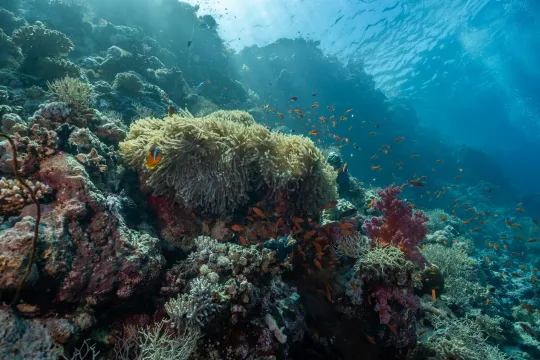
- The visual aspects of the virtual field trip are stunning and will help students gain an appreciation for the coral, its beauty, and all it does for us.
Prerequisites
- The virtual fieldtrip is available at this link, just scroll down to the video titled Coral Reefs of Palau.
- Teachers may want to point out Palau on a map before watching the video to give students context.
- The CI Sanctuary links are broken, and certain other links may lead just to a site homepage, rather than the resource indicated.
Differentiation & Implementation
- Teachers can make language arts connections by showing students the clips of the coral reefs and asking them to write poems to describe them.
- Teachers may want to pause the video for students to read text boxes that appear on the screen. Alternatively, teachers can read this text aloud to students.
- After watching the video, students can select one of the species in the coral ecosystem and study its habitat, diet, and life cycle to consider how they may be affected by climate change.
- To help with retention, teachers can make copies of the discussion questions without the answers and have students use them as guided notes to fill in as they watch the video.
This resource introduces students to coral reefs. The included video features an expert marine biologist, and the teacher guide includes extensive links to additional sources. Wholly focused on conservation, the video rightly mentions climate change as a major threat to coral, and the teacher guide includes experiments on ocean acidification. This resource is recommended for teaching.
Teaching Tips
Standards
Resource Type and Format
About the Partner Provider

The Nature Conservancy
The Nature Conservancy is a global environmental nonprofit working to create a world where people and nature can thrive. The Nature Conservancy has grown to become one of the most effective and wide-reaching environmental organizations in the world.
Scientist Reviewed
This resource has been reviewed by SubjectToClimate's climate scientists and verified for scientific accuracy and up-to-date information. Our review process ensures that every resource in our library reflects the current state of climate science.
Learn about our review process →