
Food Systems
Provided by: Ten Strands|Published on: July 3, 2025
Grades: 1
Type: Lesson Plans
Subjects: Science, Social Studies
Authors: Seeds to Solutions, Ten Strands
Region: California
Languages: English
This resource has been reviewed by SubjectToClimate's climate scientists and verified for scientific accuracy and up-to-date information. Learn about our review process →
This resource has been reviewed by SubjectToClimate's climate scientists and verified for scientific accuracy and up-to-date information. Learn about our review process →
Synopsis
- In this 9-lesson Seeds to Solutions unit from Ten Strands and the San Mateo County Office of Education, students will understand what happens to food waste, why it is important to reduce food waste, and how they can start taking action.
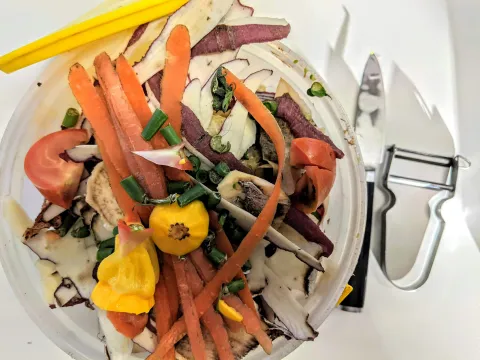
- Students will predict what happens to food when it gets thrown away, explore how food decomposes in a compost bin, discover how landfills work, analyze how wasted food impacts their community, discuss reasons for food waste in their lunchroom, brainstorm solutions to reduce lunchroom food waste, and come up with a project to solve their local food waste problem.
- Each lesson has many parts and will take multiple class periods to complete.
Teaching Materials
Positives
- Students will love the Composting for Kids and Food Share Table videos, which will empower them to see how kids like them are making a difference in their schools and communities.
- By adding to the "How did we figure it out?" column, students are actively connecting learning experiences with their purpose and attending to their learning in a thoughtful way.
- Through this unit, students will gain an appreciation for the work that has gone into the food that they eat from start to finish, which is important to recognize.
Prerequisites
- For Lesson 3, teachers will need the book Pumpkin Jack by Will Hubbell and Compost Stew: An A to Z Recipe for the Earth by Mary McKenna Siddals.
- For Lesson 8, teachers will need the book PB&J Hooray!: Your Sandwich’s Amazing Journey from Farm to Table by Janet Nolan.
Differentiation & Implementation
- Many students may have had the experience of leaving food in the fridge or a lunchbox for too long and having it start to go bad. In Lesson 3, teachers can connect to the students' background experience by asking them to recall a time like this and relate it to decomposition.
- Teachers can also connect to background knowledge students may have about farming or gardening. Teachers can ask about how students may have used fertilizer and explain that compost, just like fertilizer, is used to help plants grow.
- To make community connections and provide local context, teachers can invite farmers and other community members to the classroom during Lesson 8 to explain their role in the local food system.
This resource presents the issue of food waste with a focus on student action. The slideshows and sheets are all well-sourced, and an extensive list of unit references is included. Grounded in sound climate science, the lessons focus on reducing food waste, which will minimize methane emissions from landfills. This resource is recommended for teaching.
Teaching Tips
Standards
Resource Type and Format
About the Partner Provider
-thumb.webp)
Ten Strands
Ten Strands is a California–based nonprofit established in 2012. Their mission is to strengthen the partnerships, strategies, and systems that advance environmental literacy, ensuring all California TK–12 students thrive in sustainable, resilient schools and engage in meaningful environmental learning experiences, both in and beyond the classroom. They operate with a small, diverse, and nimble staff and strategic partners throughout the state. Ten Strands utilizes the largest and most diverse institution in California—the public school system—to impact 58 county offices of education, more than 1,000 school districts, approximately 10,000 individual schools, over 300,000 teachers, and 5.8 million children.
Scientist Reviewed
This resource has been reviewed by SubjectToClimate's climate scientists and verified for scientific accuracy and up-to-date information. Our review process ensures that every resource in our library reflects the current state of climate science.
Learn about our review process →