

Lizards in Hurricanes
Provided by: BioInteractive|Published on: February 9, 2026
Grades: 9, 10, 11, 12, AP
Type: Lesson Plans
Subjects: Biology
Authors: BioInteractive
Region: U.S. Caribbean Islands
Languages: English, Spanish

This resource has been reviewed by SubjectToClimate's climate scientists and verified for scientific accuracy and up-to-date information. Learn about our review process →
This resource has been reviewed by SubjectToClimate's climate scientists and verified for scientific accuracy and up-to-date information. Learn about our review process →
Synopsis
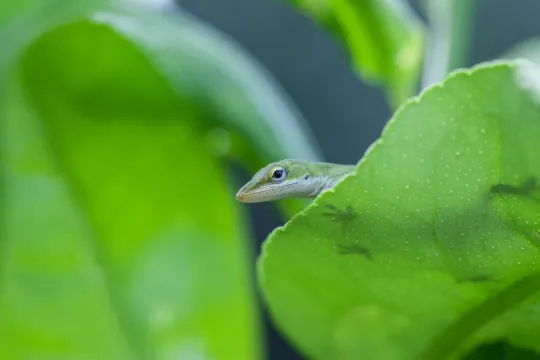
- This resource from BioInteractive focuses on a study done by researchers in the Caribbean to determine the influence of hurricanes on the genetic makeup of anole lizard poopulations.
- Students will analyze images of the lizards from the study, discuss what this study implies in the broader context of evolution, and complete other activities to explore natural selection, evolution, and animal traits.
Teaching Materials
Positives
- This resource includes links and suggestions for a variety of other activities, giving teachers many opportunities to build on students' interests and expand on their skills.
- Students will enjoy the video describing the study and demonstrating the experiment.
Prerequisites
- Teachers may not have access to the original paper linked in the Educator Materials.
- To begin the Lizard Evolution Virtual Lab, students will need to select the module in the top left section.
Differentiation & Implementation
- To make connections to climate change, teachers can discuss how climate change is impacting the frequency and severity of hurricanes. Teachers can use this lesson as a follow-up or a precursor to the activity.
- To continue the topic of the impacts of climate change on species' evolution, teachers can implement this podcast episode, or have students discuss the combined effects of climate change, habitat loss, deforestation, pollution, and overharvesting on extinctions and biodiversity loss.
- Teachers can use this resource to make connections to the Sustainable Development Goals, especially Goal 15, Life on Land.
- Teachers can cut the images from the student handout into strips, having students analyze one of the lizards at a time, with each student studying a different lizard. Students can then pair up or group up to discuss the differences between their lizards.
In this lesson, students will examine a series of pictures and a video that are a part of an experiment to identify what traits of the lizards help them stay attached to trees during extreme wind. The lesson is implying that extreme weather is a factor that helps select which traits a species may have in the future. It also implies that because climate change affects the number and intensity of these extreme events, it is influencing the evolution process. It may be helpful to give additional information about evolution, how long the process can take, and what a selective force is. The information presented is accurate, and the resource is recommended for teaching.
Teaching Tips
Standards
Resource Type and Format
About the Partner Provider

BioInteractive
BioInteractive brings the power of real science stories into tens of thousands of high school and undergraduate life science classrooms.
Scientist Reviewed
This resource has been reviewed by SubjectToClimate's climate scientists and verified for scientific accuracy and up-to-date information. Our review process ensures that every resource in our library reflects the current state of climate science.
Learn about our review process →