
Perennial Staple Crops
Provided by: Project Drawdown|Published on: October 31, 2023
Grades: 9, 10, 11, 12, AP
Type: Articles/Websites
Subjects: Earth and Space Sciences, English Language Arts
Authors: Project Drawdown
Region: Global
Languages: English
This resource has been reviewed by SubjectToClimate's climate scientists and verified for scientific accuracy and up-to-date information. Learn about our review process →
This resource has been reviewed by SubjectToClimate's climate scientists and verified for scientific accuracy and up-to-date information. Learn about our review process →
Synopsis
- This resource is currently being revised by Project Drawdown but you can research many of the other solutions in detail on their new Drawdown Explorer page.
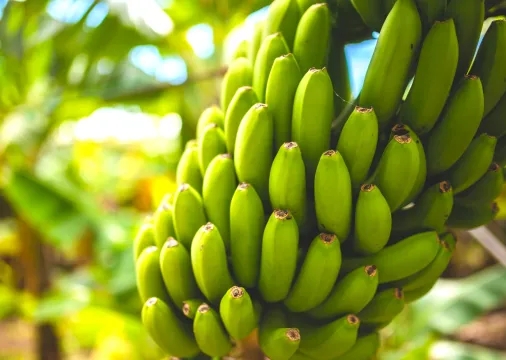
- This article explores the benefits of planting perennial staple crops such as bananas and avocados rather than annual staple crops such as maize, wheat, potatoes, and soybeans.
- Several benefits of perennial staple crops are discussed, such as higher yields, carbon sequestering, and the ability to thrive under harsh conditions.
- The projected data is analyzed to provide evidence for a cost-efficient plan involving substituting perennial staple crops whenever and wherever possible.
Teaching Materials
Positives
- The information is formatted like a scientific paper, with a clear cause-and-effect framework.
- Helpful sidebars present numerical data with easy-to-understand graphics and include a call to action for students.
- Students and teachers can easily share this article via social media.
Additional Prerequisites
- The vocabulary is rigorous, so a definition list is appropriate.
- Students should have a basic understanding of "hectare" versus "acre" since the data is in hectares.
Differentiation
- Probability and statistics connections can be made in math classes, as there are several data points to evaluate costs, benefits over time, and effects on the climate.
- Students in English or language arts classes can use the article to evaluate the author's purpose and scientific writing styles or as practice for reading more complex scientific papers.
- For small-group instruction, students can work together by taking notes on each section and creating questions about their assigned portion. Then, students can trade questions with other groups, ending with a student-led discussion.
- This article is relevant for any discussion related to perennial versus annual crops and the effects of each on the environment. Students can also research other agricultural solutions from the Table of Solutions.
This resource presents a scenario analysis of planting perennial staple crops on nondegraded grassland and cropland. Perennial staple crops have the two-fold benefit of providing needed foods such as avocados and palm oil at a higher yield than annual staples and sequestering carbon. The article considers two scenarios for the initial cost, operational costs, profit, and carbon sequestration. The authors assume that perennial staple crops will only be planted on nondegraded grassland and cropland rather than on cleared forests but admit that forests are often cleared to plant these crops. This resource is well sourced, clear, and is recommended for teaching.
Teaching Tips
Standards
Resource Type and Format
About the Partner Provider

Project Drawdown
Project Drawdown is a nonprofit organization that seeks to help the world reach “drawdown”—the future point in time when levels of greenhouse gases in the atmosphere stop climbing and start to steadily decline. Cities, universities, corporations, philanthropies, policymakers, communities, educators, activists, and more turn to Project Drawdown as they look to advance effective climate action. Project Drawdown resources for educators include the database of Drawdown Solutions, educational video series Climate Solutions 101, the Drawdown Stories initiative, and more.
Scientist Reviewed
This resource has been reviewed by SubjectToClimate's climate scientists and verified for scientific accuracy and up-to-date information. Our review process ensures that every resource in our library reflects the current state of climate science.
Learn about our review process →