
Tailoring Forest Monitoring in Madagascar
Provided by: Global Forest Watch|Published on: October 27, 2025
Grades: 9, 10, 11, 12, AP
Type: Articles/Websites
Subjects: Biology
Authors: LUCIENNE WILMÉ, OLLIER ANDRIANAMBININA, SARAH CARTER AND KEVIN FARAGHER
Region: Africa
Languages: English
This resource has been reviewed by SubjectToClimate's climate scientists and verified for scientific accuracy and up-to-date information. Learn about our review process →
This resource has been reviewed by SubjectToClimate's climate scientists and verified for scientific accuracy and up-to-date information. Learn about our review process →
Synopsis
- This article from Global Forest Watch explains how to use both tree canopy density and tree loss data to measure deforestation in Madagascar that is specific to natural forests that support biodiversity.
- Students will learn how Global Forests Watch shifted their model to help those who live in Madagascar make decisions about deforestation based on the most accurate and relevant data, in an effort to protect biodiversity.
Teaching Materials
Positives
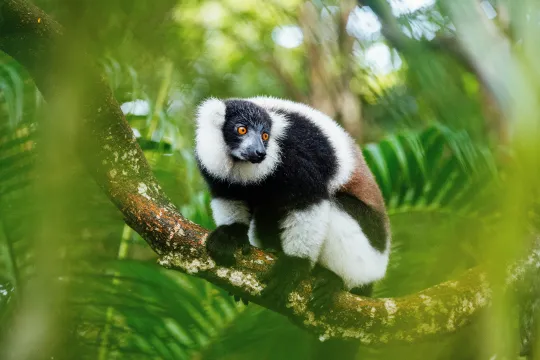
- Students will love the images of Madagascar species scattered throughout the article.
- This article does a great job of explaining the methods for data collection in a way that is easy to understand for those who have no prior knowledge of the subject.
Prerequisites
- Teachers may want to familiarize students with Madagascar's location and endemic species.
- It may benefit students to understand that different trees and forest types provide different kinds of habitats.
Differentiation & Implementation
- To help students synthesize the information in this article, teachers may have them answer three questions: What was the problem? Why was it important? How did it get solved?
- This article uses a lot of abbreviations. To help students keep these straight, teachers may want to create a cheat sheet or write them on the board for students to refer back to as they read.
- To make connections to climate change, teachers can review with students the importance of trees, especially old-growth forests, in the sequestration of carbon. This video may be a helpful resource to present this concept.
- Teachers can use this resource to make connections to the Sustainable Development Goals, especially SDG 15, Life on Land.
This resource details how global tree cover data was filtered to create a clear picture of deforestation in Madagascar. Throughout, focus is placed on understanding deforestation in order to inform conservation efforts. The article is exceptionally well-sourced, with several peer-reviewed articles linked in the text. This resource is recommended for teaching.
Teaching Tips
Standards
Resource Type and Format
About the Partner Provider
Global Forest Watch
Global Forest Watch (GFW) is an online platform that provides data and tools for monitoring forests. By harnessing cutting-edge technology, GFW allows anyone to access near real-time information about where and how forests are changing around the world. GFW is used every day to monitor and manage forests, stop illegal deforestation and fires, call out unsustainable activities, defend land and resources, sustainably source commodities, and conduct research at the forefront of conservation.
Scientist Reviewed
This resource has been reviewed by SubjectToClimate's climate scientists and verified for scientific accuracy and up-to-date information. Our review process ensures that every resource in our library reflects the current state of climate science.
Learn about our review process →