
Ticks, Disease, and Climate Module
Provided by: Gulf of Maine Research Institute|Published on: January 15, 2024
Grades: 5, 6, 7, 8
Type: Lesson Plans
Subjects: Biology, Earth and Space Sciences
Authors: Gulf of Maine Research Institute
Region: North America, USA - Northeast, United States, Maine
Languages: English
This resource has been reviewed by SubjectToClimate's climate scientists and verified for scientific accuracy and up-to-date information. Learn about our review process →
This resource has been reviewed by SubjectToClimate's climate scientists and verified for scientific accuracy and up-to-date information. Learn about our review process →
Synopsis
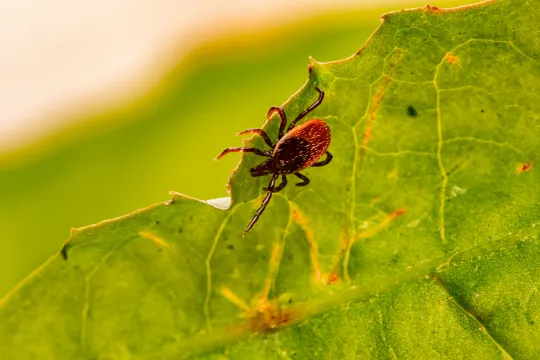
- In this four-lesson module, students will learn about the increasing tick-borne diseases in the Northeast due to climate change.
- Students will read about ticks, play a memory game to distinguish types of ticks, play an interactive game modeling the life cycle of a tick, analyze maps to determine the relationship between tick range, Lyme disease, temperature, and precipitation, and create an action plan to protect the community from tick-borne disease.
Teaching Materials
Positives
- Students will love the engaging games and many opportunities to collaborate with their peers.
- The action plan gets students positively involved in their community.
Additional Prerequisites
- The module has four lessons, but some may require more than one class period. Teachers may need to spend about 5-8 class periods on the module.
- The module provides background information with sources, guiding questions/discussion topics, student pages, class slides, and assessment rubrics for each lesson.
- There is some minimal prep teachers will need to do before each lesson, such as printing, cutting, setting up stations, etc.
- Teachers need 10-15 six-sided dice for two of the lessons.
- Students should be familiar with climate change and the specific local impacts in the Northeast region. If additional foundational instruction is needed, there is a link to two lessons that teachers can add to this module.
Differentiation
- The action plan in the final lesson can act as a summative assessment for the module, and the guide includes a rubric for this.
- There are multiple options for how teachers can implement the action plans in the community.
- Cross-curricular connections can be made with English language arts classes when students read nonfiction text on ticks and synthesize information from multiple sources.
- Teachers can make cross-curricular connections with math classes in the data collection, analysis, and graphing portions.
This resource from the Gulf of Maine Research Institute provides lesson plans that discuss the effects of climate change on the Northern New England ecosystems and how these changes have affected the tick populations, impacting the community health. This resource provides students with the ability to visualize and interpret data, along with brainstorming ways they can take action to help stop climate change. This resource is recommended for teaching.
Teaching Tips
Standards
Resource Type and Format
Scientist Reviewed
This resource has been reviewed by SubjectToClimate's climate scientists and verified for scientific accuracy and up-to-date information. Our review process ensures that every resource in our library reflects the current state of climate science.
Learn about our review process →