
Tracking Water Using NASA Satellite Data
Provided by: NASA|Published on: November 21, 2023
Grades: 4, 5, 6, 7, 8
Type: Lesson Plans
Subjects: Earth and Space Sciences, Mathematics, Engineering
Authors: NASA Jet Propulsion Laboratory
Region: Global
Languages:
This resource has been reviewed by SubjectToClimate's climate scientists and verified for scientific accuracy and up-to-date information. Learn about our review process →
This resource has been reviewed by SubjectToClimate's climate scientists and verified for scientific accuracy and up-to-date information. Learn about our review process →
Synopsis
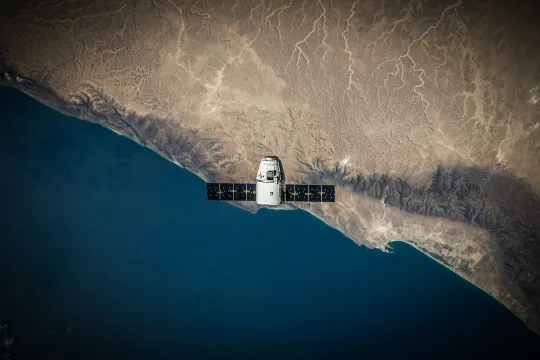
- In this lesson, students graph data collected by NASA's GRACE satellites and look at trends in the water mass of different locations.
- Students learn how the satellites use the concepts of gravity and mass to track water, why tracking water is increasingly important, and how water content has changed over a decade.
Teaching Materials
Positives
- The videos, animation, and maps make this lesson great for visual learners.
- The graphing portion of the lesson is an excellent practice in collaboration with every small group responsible for a different year of data.
Additional Prerequisites
- There is a lesson on how to read heat maps linked in the Management section that teachers may want to use before doing this activity.
- Students should know how to graph data along an x- and y-axis.
- It may benefit students to understand the water cycle.
Differentiation
- Language arts students can write an informational piece to explain how the GRACE satellites work and what they measure.
- Geography classes can discuss how the trends in water in different locations will impact the people who live there.
- Students can discuss how climate change impacts the water cycle, sea level rise, and glacial melt.
- Younger classes who struggle with independently graphing the data can complete the graphs as a whole class, doing one or two years a day, and possibly gradually releasing responsibility as students become familiar with the process.
- Some students may need to spend more time with the definitions and explanations for mass and gravity before understanding how the satellites work.
This resource is from the CLEAN collection. “The CLEAN collection is hand-picked and rigorously reviewed for scientific accuracy and classroom effectiveness.”
Teaching Tips
Standards
Resource Type and Format
Scientist Reviewed
This resource has been reviewed by SubjectToClimate's climate scientists and verified for scientific accuracy and up-to-date information. Our review process ensures that every resource in our library reflects the current state of climate science.
Learn about our review process →